


The History of the 64-Count Box of Crayola Crayons
- Crayolona
- 5 days ago
- 3 min read
Few art supplies carry the cultural weight of the 64-count box of Crayola crayons. For many of us, it wasn’t just a box of crayons — it was a milestone. A promotion. A status symbol in elementary school. And, of course, it had the built-in sharpener.
But how did the 64-count box become such an icon?
Let’s take a colorful walk through its history.
The Early Years: Before 64
Crayola introduced its first box of eight crayons in 1903. For decades, smaller assortments were the norm — 8, 16, and 24-count boxes were common classroom staples. As printing technology improved and demand for more color variety grew, Crayola gradually expanded its offerings.
By the mid-20th century, color variety wasn’t just practical — it was exciting. Children didn’t just want “red” and “blue.” They wanted Burnt Sienna, Periwinkle, and Blue-Green.
The appetite for more shades was growing.

1958: The Arrival of the 64-Count Box
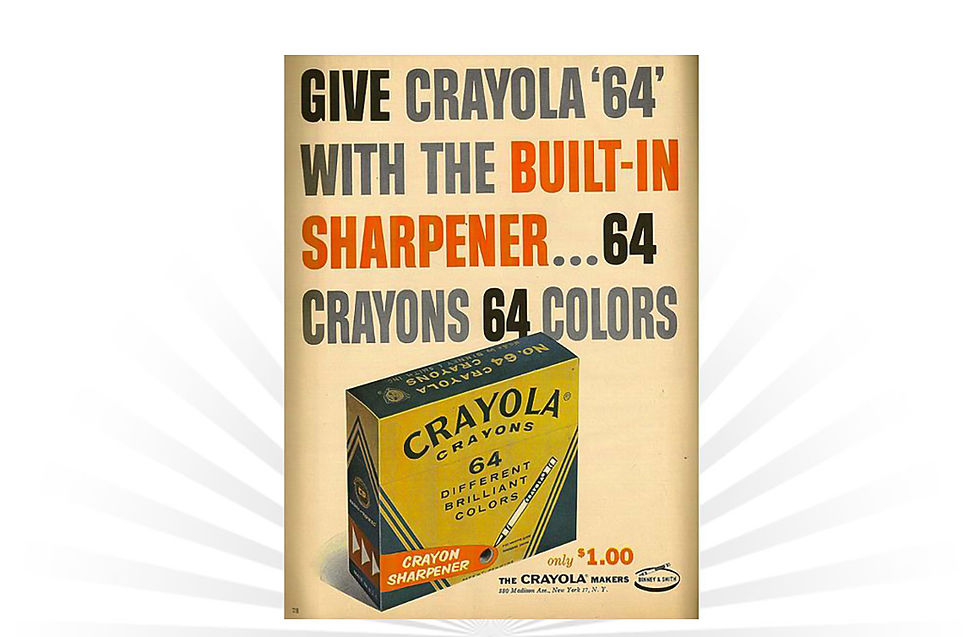
The 64-count box of Crayola crayons was introduced in 1958, and it was a game changer.
For the first time, children had access to an expansive spectrum of colors in one package. The box wasn’t just bigger — it was transformative. Sixty-four crayons meant deeper sunsets, richer forests, more expressive portraits, and endless imaginative combinations.
But what truly set it apart?
The built-in sharpener.
Mounted on the back of the box, the small metal sharpener became part of the ritual. Carefully twisting a worn-down crayon back to life felt almost ceremonial. It wasn’t just about maintenance — it was about caring for your colors.
A Classroom Status Symbol
If you grew up in the 1970s, 80s, or 90s, you probably remember this clearly: bringing a 64-count box to school felt like leveling up.
While many classmates carried 16- or 24-count sets, the 64-count box felt deluxe. It offered choices. Options. Power. It meant you didn’t have to compromise between Goldenrod and Dandelion.
It was abundance in cardboard form.
Over time, the box itself became visually iconic — bold yellow packaging, neatly tiered rows of crayons, and that satisfying moment of lifting the lid to reveal perfectly aligned color tips.
Color Changes Through the Years
The 64-count assortment hasn’t been static. As Crayola retired and introduced new colors, the contents of the box evolved.
Some shades disappeared, including beloved favorites like Dandelion (retired in 2017). Others were added to reflect changing trends and cultural awareness. The box became a living record of design shifts, marketing choices, and social awareness over time.
For collectors, this means vintage 64-count boxes can tell you exactly when they were produced based on which colors appear inside.
The 64-Count Box as Cultural Artifact
More than a product, the 64-count box became embedded in American pop culture.
It appeared in:
classrooms across generations
back-to-school advertisements
gift lists
nostalgia-driven media
It represents creativity before screens — long afternoons coloring at the kitchen table, carefully choosing just the right shade for a sky or a shirt.
For many adults today, rediscovering a 64-count box feels like reconnecting with a simpler, more tactile time.
Why It Still Matters
Despite the rise of markers, digital art tablets, and endless creative tools, the 64-count box remains one of Crayola’s most enduring products.
Why?
Because it strikes a perfect balance:
Large enough to feel abundant
Compact enough to feel manageable
Diverse enough to inspire
It continues to be a rite of passage for young artists and a nostalgic treasure for collectors.
A Personal Note
For many collectors (myself included), the 64-count box is often where the story begins. It’s rarely the very first crayon box we owned — but it’s the one we remember most clearly.
There’s something about opening that lid and seeing rows of color that still feels like possibility.
And maybe that’s why the 64-count box endures — not just as a product, but as a symbol of imagination in its purest form.
Comments